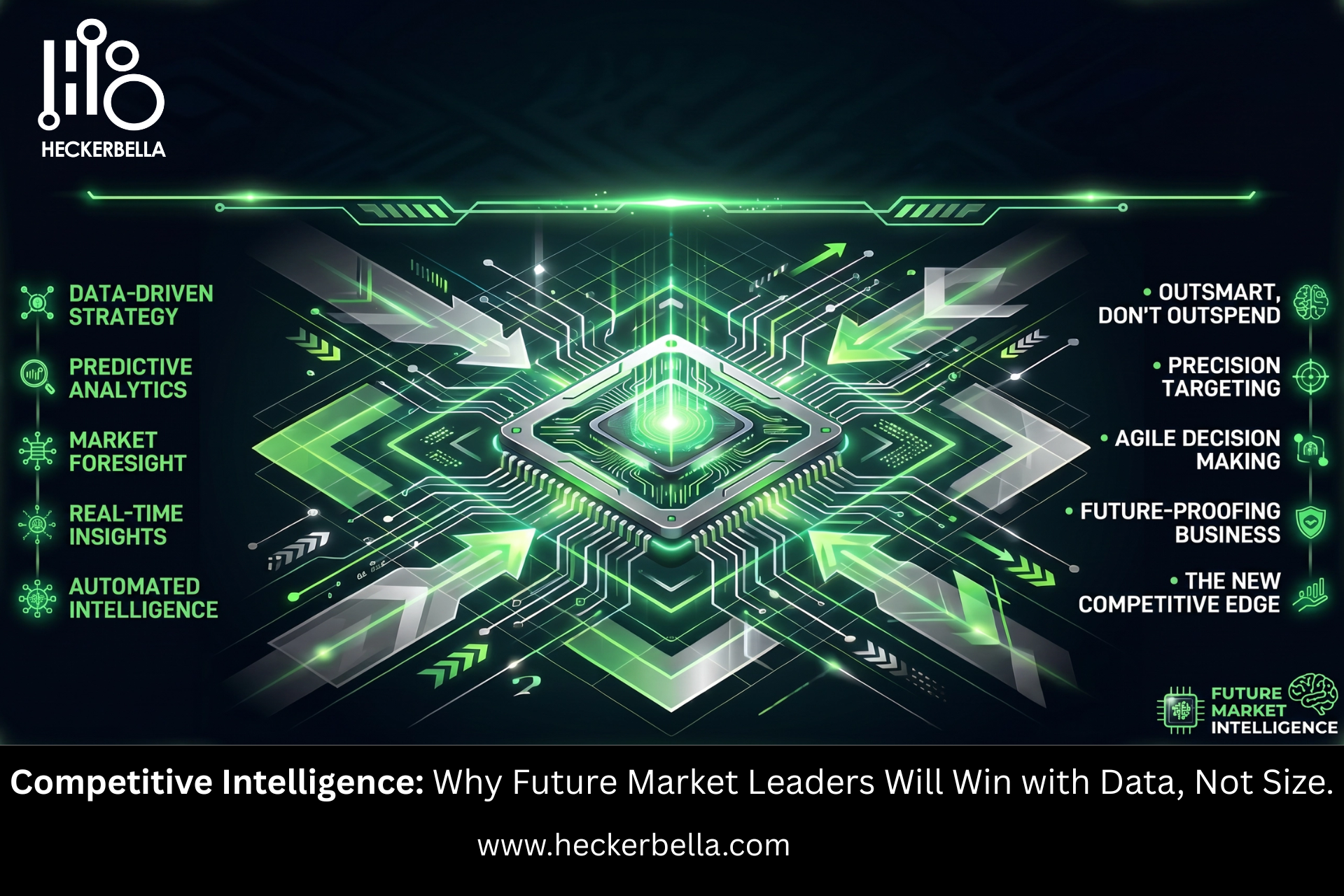
Competitive Intelligence: Why Future Market Leaders Will Win with Data, Not Size
For a long time, business success was closely tied to size.
The biggest companies had the largest budgets, the strongest brands, the widest reach, and the resources to outspend competitors. Scale was a competitive advantage that was difficult to challenge.
That is no longer the case.
Today, some of the fastest-growing businesses aren’t winning because they’re the biggest, they are winning because they make better decisions, faster.
The advantage has shifted from size to intelligence.
At Heckerbella, we believe the organisations that will lead the next decade won’t necessarily have the most employees or the biggest market share. They’ll be the ones that can gather insights quickly, understand what those insights mean, and act before everyone else.
In today’s market, learning faster has become a competitive advantage.
Why Size Isn’t Enough Anymore
Large organisations still have significant advantages. They have resources, established customer bases, and operational scale.
But they also tend to have more layers of decision-making, more complex processes, and more disconnected systems.
In fast-moving markets, that complexity can slow organisations down. Meanwhile, technology has levelled the playing field. Cloud platforms, business intelligence tools, AI, customer analytics, and automation have made powerful insights accessible to organisations of every size. A growing business can now access information that was once only available to large enterprises.
The difference is no longer who has access to data.
It’s who knows what to do with it.
Customer behaviour changes quickly. New competitors emerge overnight. Market conditions shift without much warning.
Businesses that can spot these changes early and respond with confidence are increasingly outperforming those relying on scale alone.
Data Doesn’t Create Advantage, Action Does
Most organisations already have plenty of data. Sales reports, customer feedback, website analytics, financial dashboards, operational metrics, employee surveys, the information is there. Yet many businesses still struggle to make timely decisions.
Why?
Because collecting data is only the first step.
The real value comes from turning information into insight, and insight into action.
Every customer interaction tells a story. Every sales conversation reveals changing market needs. Every operational process generates signals about what’s working and what isn’t.
Organisations that can connect these signals and use them to make better decisions gain an advantage that competitors can’t easily replicate.
Competitive intelligence isn’t about having more reports.
It’s about building the capability to learn continuously.
What Competitive Intelligence Looks Like
Building a more intelligent organisation goes beyond investing in new technology. It requires systems, processes, and a culture that supports better decision-making.
Here are five capabilities that increasingly separate market leaders from everyone else.
- Real-Time Visibility
Successful organisations don’t wait for quarterly reports to understand what’s happening.
They monitor customer behaviour, competitor activity, industry trends, and business performance in real time. Early visibility allows leaders to identify opportunities and respond to risks before they become bigger problems.
- Connected Information
One of the biggest barriers to good decision-making is fragmented data.
When customer information, financial performance, operational metrics, and workforce insights all exist in separate systems, leaders never see the complete picture.
Integrated data creates a clearer understanding of the business and enables more informed decisions.
- Predictive Thinking
Competitive intelligence isn’t only about understanding the present.
It’s also about preparing for what’s next.
Modern analytics and AI can help organisations identify patterns, forecast demand, anticipate customer behaviour, and model future scenarios.
The goal isn’t to predict the future perfectly.
It’s to make better decisions before competitors do.
- Organisational Agility
Insight only creates value when it leads to action.
Many businesses know what needs to change but struggle to move quickly because of slow approval processes or rigid organisational structures.
High-performing organisations reduce unnecessary friction so teams can make informed decisions and execute with confidence.
- A Culture of Curiosity
Technology provides information.
People create intelligence.
The organisations that consistently outperform their competitors encourage curiosity at every level. They ask better questions, challenge assumptions, seek feedback, and remain open to new ideas.
That mindset is often what turns data into innovation.
What This Means for Business Leaders
Leadership is changing.
The role of executives is no longer just to review reports and approve decisions.
It’s to create an organisation that learns continuously.
That means investing in more than technology. It means building systems where information flows freely, encouraging collaboration across teams, and creating processes that allow insights to influence decisions quickly.
Perhaps the most important leadership question is no longer:
“How can we grow bigger?”
It’s:
“How can we become smarter?”
Because organisations that learn faster are often the ones that adapt faster.
And organisations that adapt faster are the ones most likely to lead their markets.
Looking Ahead
Competition is no longer simply about who has the biggest budget or the largest workforce.
It’s about who can recognise change first and respond with confidence.
At Heckerbella, we believe competitive intelligence is becoming one of the defining capabilities of modern organisations. Businesses that combine connected data, real-time insight, and agile decision-making will be better positioned to navigate uncertainty and seize new opportunities.
The future belongs to organisations that treat data as more than information. They treat it as a strategic asset that drives every decision.
Because in today’s economy, competitive advantage isn’t owned by the biggest organisations.
It’s earned by the fastest learners.