Every major technological revolution creates anxiety about human relevance. The Industrial Revolution raised concerns about machinery replacing manual labour. The rise of computers sparked fears that knowledge workers would become obsolete. Today, artificial intelligence has become the latest source of uncertainty, with headlines frequently asking whether machines will replace accountants, marketers, software developers, customer service representatives, managers and even executives.
While these concerns are understandable, they are increasingly distracting organisations from a far more important conversation. The real question is no longer whether AI will replace certain tasks. In many cases it already has. The more important question is what remains uniquely human when machines become capable of performing an increasing share of operational, analytical and administrative work.
At Heckerbella, we believe this distinction will define the next era of business leadership. The future of work will not be determined by what artificial intelligence can do. It will be determined by what humans choose to do once artificial intelligence handles everything it can. Organizations that understand this shift will position themselves to thrive in an AI economy. Those that focus exclusively on automation may discover that efficiency alone is not enough to sustain competitive advantage.
The greatest misunderstanding surrounding AI is the assumption that business value is created primarily through task execution. Historically this was often true. Organizations rewarded speed consistency accuracy and productivity because these capabilities were difficult to scale. Artificial intelligence is rapidly changing that equation. As machines become increasingly capable of executing routine tasks the scarcity shifts elsewhere. The new premium is not on execution alone but on judgment creativity trust adaptability and human insight.
In many ways the rise of AI is not reducing the importance of people. It is forcing organizations to rediscover what makes people valuable in the first place.
Why Efficiency Is No Longer a Sustainable Competitive Advantage
For decades businesses pursued efficiency as a primary strategic objective. Processes were optimized costs were reduced workflows were standardized and productivity was measured with increasing precision. Organizations that could perform activities faster and more efficiently than competitors often gained significant advantages.
Artificial intelligence is rapidly democratizing efficiency.
Tasks that once required large teams can now be completed by a fraction of the workforce. Data analysis that previously consumed days can be completed within minutes. Content can be generated instantly. Customer inquiries can be resolved automatically. Reports can be produced with minimal human involvement. What was once considered a unique operational strength is becoming widely accessible.
This creates a strategic challenge for business leaders. If every organization can access increasingly similar levels of efficiency through AI-powered tools efficiency itself becomes less differentiating.
History provides useful lessons. Access to electricity eventually stopped being a competitive advantage because everyone gained access to it. Internet connectivity followed a similar pattern. The same will likely occur with many AI capabilities. Organizations that rely solely on AI adoption as a differentiator may find that their competitors quickly gain access to similar technologies.
The companies that pull ahead will be those that combine technological capability with uniquely human strengths that cannot be replicated through algorithms alone.
The Heckerbella Perspective: The More Intelligent Machines Become the More Valuable Human Judgment Becomes
One of the most significant misconceptions about artificial intelligence is that intelligence and judgment are the same thing.
They are not.
Artificial intelligence excels at identifying patterns processing information generating outputs and optimizing within defined parameters. However business leadership often requires something fundamentally different. Leaders must navigate ambiguity weigh competing priorities balance short-term and long-term interests interpret context and make decisions when complete information is unavailable.
These situations require judgment.
A machine can analyze customer behavior and identify trends. It cannot fully understand the emotional dynamics behind a damaged customer relationship. A machine can generate strategic options. It cannot fully appreciate the cultural implications of a decision within a particular organization. A machine can evaluate probabilities. It cannot assume accountability for the consequences of those decisions.
The future therefore belongs not to organizations that replace human judgment with artificial intelligence but to those that amplify human judgment through artificial intelligence.
In this emerging model AI becomes a powerful advisor while humans remain responsible for interpretation prioritization and decision-making. The organizations that master this partnership will gain advantages that neither humans nor machines could achieve independently.
Five Human Capabilities That Will Become More Valuable in the AI Economy
- Strategic Judgment
As artificial intelligence increases access to information and analysis leaders will face an abundance of insights rather than a shortage of them. The challenge will no longer be obtaining data. The challenge will be determining which actions should be taken and why.
Strategic judgment requires experience perspective ethical reasoning and contextual understanding. These capabilities cannot be downloaded automated or generated through data alone. As AI expands access to information the ability to make sound judgments based on that information will become even more valuable.
- Creativity and Original Thinking
Artificial intelligence is exceptionally effective at synthesizing existing knowledge. However breakthrough innovation often emerges from challenging assumptions redefining problems and imagining possibilities that do not yet exist.
The organizations that create the future rarely do so by repeating patterns from the past. They succeed because individuals identify opportunities others fail to see. Human creativity remains one of the most powerful sources of differentiation in an increasingly automated world.
- Trust and Relationship Building
Business ultimately operates through relationships. Customers buy from organizations they trust. Employees commit to leaders they believe in. Partners collaborate when confidence exists between parties.
Trust is not built through algorithms alone. It is built through credibility empathy communication consistency and human connection. As digital interactions become more automated authentic human relationships may become even more valuable because they become increasingly rare.
- Adaptability in Uncertain Environments
Artificial intelligence performs best when operating within identifiable patterns. Human beings however possess an extraordinary ability to adapt when patterns break down.
Markets change unexpectedly. Customer expectations shift. Crises emerge without warning. New opportunities appear where no historical data exists.
In these moments adaptability becomes more important than optimization. Organizations that cultivate adaptable leaders and employees will be better equipped to navigate uncertainty than those that depend exclusively on predefined systems and algorithms.
- Ethical Leadership
As artificial intelligence becomes embedded within business operations ethical questions will become increasingly complex. Decisions about privacy fairness accountability transparency workforce transformation and responsible technology use cannot be delegated entirely to machines.
Organizations will need leaders capable of balancing innovation with responsibility. The ability to make principled decisions that protect stakeholders while driving growth will become a defining characteristic of successful businesses in the AI era.
The rise of artificial intelligence requires leaders to rethink how talent is developed measured and deployed.
Many organizations still evaluate employees primarily based on productivity task completion and operational efficiency. While these capabilities remain important they are increasingly becoming areas where machines can provide substantial support.
The greatest value from people will increasingly come from capabilities that are difficult to automate: leadership collaboration creativity strategic thinking relationship management innovation and judgment.
This means workforce development strategies must evolve accordingly. Organizations should focus not only on teaching employees how to use AI tools but also on strengthening the uniquely human capabilities that become more valuable as AI adoption accelerates.
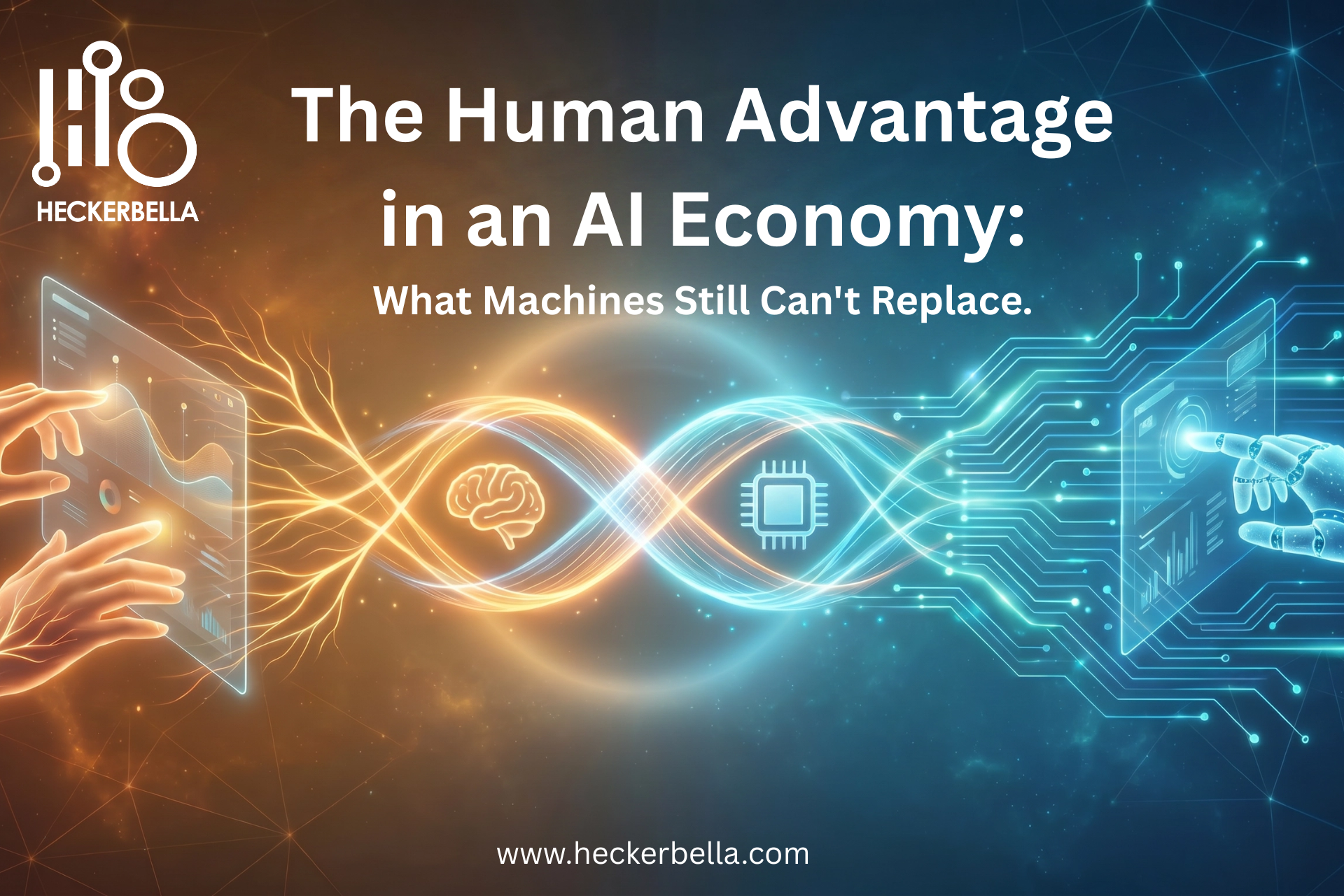
The companies that achieve the greatest success will not necessarily be those with the most advanced artificial intelligence systems. They will be those that create the most effective partnership between human intelligence and machine intelligence.
The debate about whether artificial intelligence will replace people often misses the larger opportunity unfolding before us. AI is undoubtedly transforming how work is performed but its greatest impact may not be the elimination of human contribution. Its greatest impact may be forcing organizations to redefine where human contribution creates the most value.
The organizations that thrive in the coming decade will not be those that choose between people and technology. They will be those that combine both intelligently. They will automate what should be automated, augment what should be enhanced and invest deeply in the capabilities that remain uniquely human.
Because in an AI economy, the ultimate competitive advantage will not be artificial intelligence alone.
It will be human intelligence applied where it matters most.
The future of work will not be defined by what AI can do. It will be defined by what humans choose to do once AI handles everything it can.
OUR BLOG POSTS