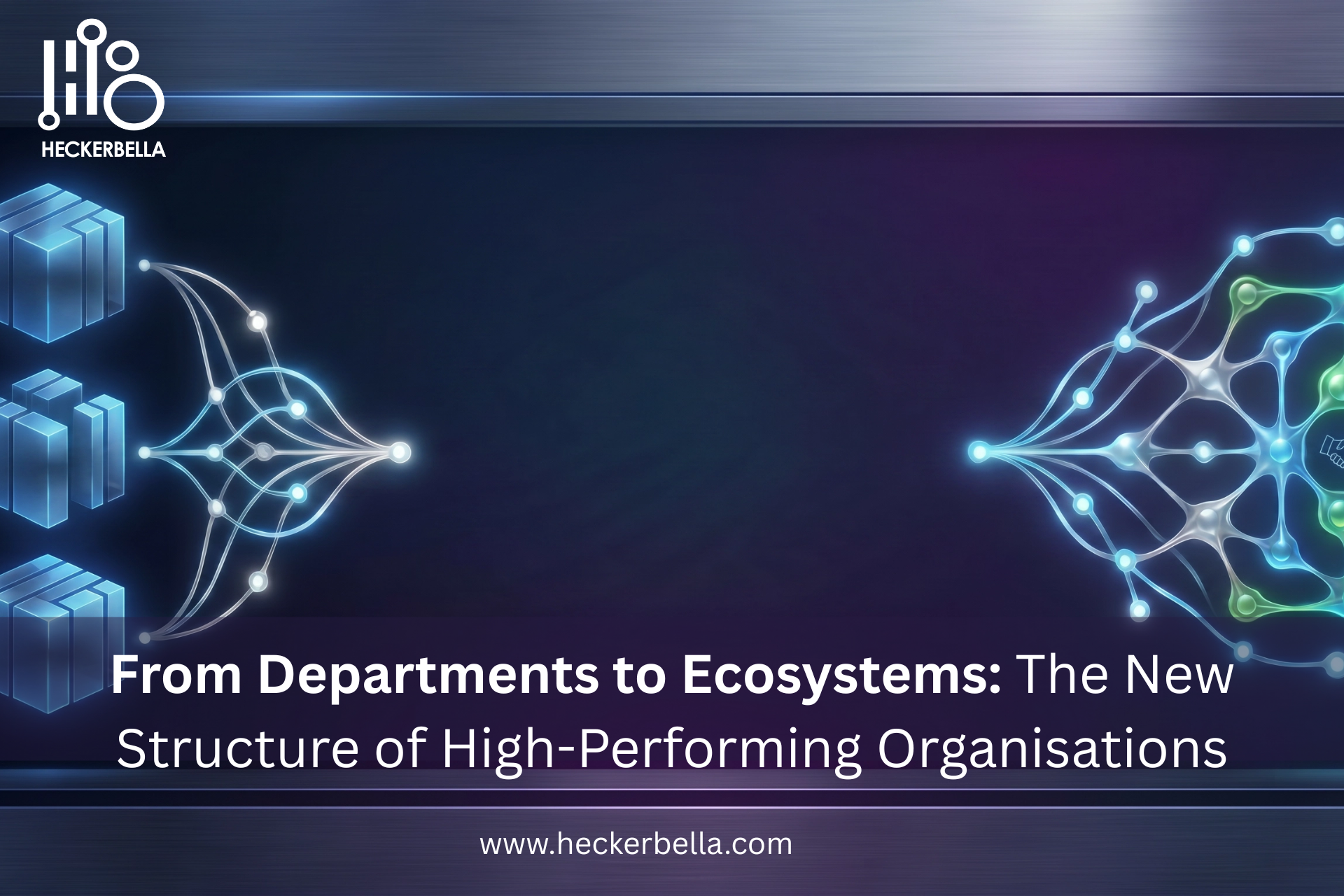
From Departments to Ecosystems: The New Structure of High-Performing Organisations
For decades, businesses have been built around departments. Finance, HR, Marketing, Operations, Sales, and Technology each had clearly defined roles, reporting lines, and goals. It was a model designed for an era where stability and efficiency drove success.
Today, that model is under pressure.
Modern organisations operate in a world of constant change. Customer expectations evolve rapidly, technology connects every part of the business, and work rarely stays within the boundaries of a single department. Yet many organisations still rely on structures designed for a different business landscape.
At Heckerbella, we believe the future belongs to organisations that think beyond departments and start operating as ecosystems.
This isn’t about removing organisational structure. It’s about redesigning it around how value is actually created.
Why Traditional Departments Are No Longer Enough
Departments were created to improve efficiency through specialisation. By grouping people with similar expertise together, organisations became more productive and easier to manage.
But specialisation also created silos.
Today, delivering a single customer outcome often requires collaboration between multiple teams. Marketing generates demand, Sales converts it, Operations delivers the service, Finance manages the commercial side, while Technology supports the entire experience.
When each function operates independently, work slows down. Information gets trapped, decisions require multiple approvals, and customers experience unnecessary friction.
The problem isn’t that departments exist. It’s that many organisations still optimise individual functions instead of the business as a whole.
And in today’s environment, coordination has become just as important as capability.
Thinking Like an Ecosystem
High-performing organisations are beginning to look less like collections of departments and more like connected ecosystems.
In an ecosystem, value isn’t created by one team working in isolation. It comes from the interaction between people, processes, technology, and data.
Information moves freely instead of stopping at departmental boundaries. Teams collaborate around shared outcomes rather than individual targets. Decisions happen closer to where insights are generated, allowing organisations to respond faster and more effectively.
Technology also takes on a different role. Instead of supporting one department, it becomes the connective layer that enables the entire organisation to work as one.
The focus shifts from asking, “How can we improve this department?” to “How can we improve the flow of value across the organisation?”
That’s a very different conversation.
Three Signs Your Organisation Is Still Operating in Silos
While every organisation has functional teams, there are clear signs when departmental thinking is holding performance back.
- Decision-making is slow.
If every important decision has to move across multiple teams before action can be taken, speed becomes a competitive disadvantage.
- Success is measured differently across functions.
When departments optimise for their own KPIs without considering the bigger picture, overall business performance suffers. True organisational success comes from shared outcomes, not isolated wins.
- Information doesn’t flow easily.
When data lives in separate systems or stays within individual teams, leaders lack a complete picture of what’s happening. Poor visibility often leads to slower decisions and missed opportunities.
The Ecosystem Advantage
Organisations designed as ecosystems consistently gain three important advantages.
Speed. With fewer bottlenecks and better collaboration, teams can respond to market changes and customer needs much faster.
Intelligence. Connected systems create a clearer view of the business, allowing leaders to make more informed decisions based on real-time insights rather than fragmented information.
Adaptability. Instead of restructuring departments every time priorities change, ecosystem-based organisations adjust workflows, teams, and processes with greater flexibility.
In an environment where change is constant, adaptability becomes a competitive advantage.
What This Means for Business Leaders
Moving towards an ecosystem model doesn’t mean eliminating departments overnight.
It means shifting the focus from functions to outcomes.
Leaders should ask:
- How does work flow across our organisation?
- Where are decisions getting stuck?
- What information isn’t reaching the people who need it?
- Are our teams collaborating around shared business goals or protecting departmental priorities?
The answers often reveal that the biggest opportunities for improvement don’t sit within departments, they exist between them.
Technology also becomes a critical enabler. Integrated systems, workflow automation, and shared data platforms help remove friction and allow people to work more collaboratively.
But technology alone isn’t enough.
The real transformation is cultural. Organisations must move from managing individual functions to enabling connection across the business.
Departments are not disappearing, and they still have an important role to play. But they can no longer be the primary way organisations think about performance.
The organisations that will thrive over the next decade are those designed around connection rather than separation. They will move information faster, make better decisions, adapt more quickly, and deliver more consistent customer experiences.
At Heckerbella, we believe organisational design is no longer just about structure. It’s about creating systems that allow people, technology, and information to work together seamlessly.
Because in today’s business environment, performance isn’t defined by how strong your individual departments are.
It’s defined by how well your entire organisation works together.